Last month I felt lucky for the rare opportunity to share my interests on a stage.
Portland’s annual hardware hacking conference Teardown attracts an audience of tech-savvy artists & entrepreneurial minded open-source hardware enthusiasts that I knew would be receptive to my general message. (Great people & event, I do recommend)
My presentation, “Opportunities Everywhere! Insights from Starting a Maker Business that ChatGPT Won’t Tell You” focused on my perception of the abundance of opportunities in the hardware micro-business space.
In this post I’m going to build on some of those thoughts and share one aspect of this topic that has captured my imagination at the moment. A reason I see so much potential in this space and a possible strategy for taking this type of business to a higher level.
At 27 minutes I understand if you haven’t watched it just yet. One of the points I made is that now is a great time to start a maker business. Which is why many have done so in the last few years.
I argued that the key innovations of craft marketplace ecommerce tools, cheap capable digital fabrication tech, & freely shared resources created over the last 20 years have marinated long enough to finally reach critical mass. When the economic stress of the pandemic hit, conditions were right to trigger a wave of entrepreneurship. (Not all of it maker related of course, but plenty!)
The “maker movement” of the early 2000’s has evolved into a “maker-business movement”. Etsy is no longer just for stay at home moms selling tie-dye shirts (an old trope), and these niche tech toys are no longer just for nerds. The means of production are push-button easy and in the hands of the filthy peasants. Regular people out there are making bank producing custom small batch goods in unique ways never before possible! (Atoms are making a comeback, take that bits!)
That video just posted this weekend. Today, sitting in the shade on my deck reflecting on it, I’m left wondering: What’s next for all those micro-businesses… and for my own?
As I said, the work pays well for the time but depending on your goals & cost of living there’s still a meaningful chasm between a lucrative sideshow and the kind of opportunity that you drop everything to focus on. There’s nothing wrong with being small, but who wants to leave even better possibilities unexplored?
I try to maintain balance in my life between taking advantage of opportunities as I’m able, while continuing to explore, being be a good spouse/parent/friend/employee/etc, staying in shape, have fun & try not to work myself to death, and on and on.
Even if all your options are good, finding balance is difficult because everything demands attention and in order to do more of one thing you have. to. do. less. of. something. else.
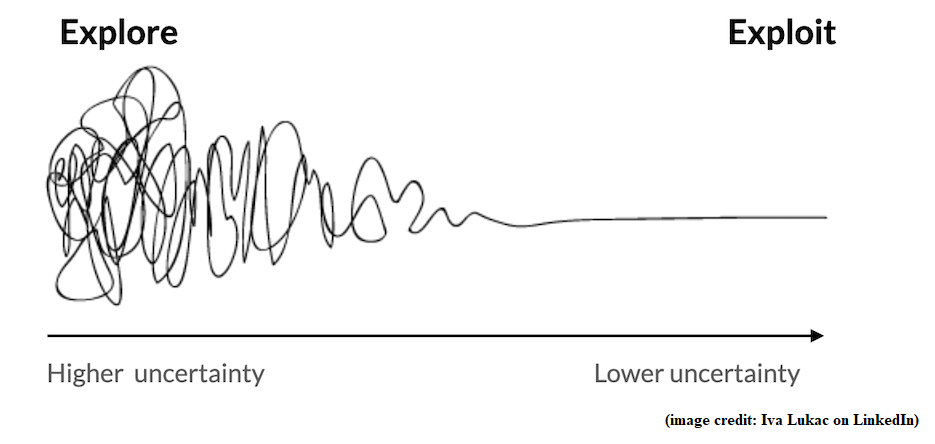
So how can we optimize the explore vs exploit trade-off? Maybe, with the right perspective, you can do both at the same time!
I’m always taking notes on interesting ideas that seem like they’ll be useful, even if it’s not clear how, when, or why it might be. As luck would have it, just days after Teardown I stumbled onto some incredible resources that helped me connect the dots and see just a bit further than I had before.
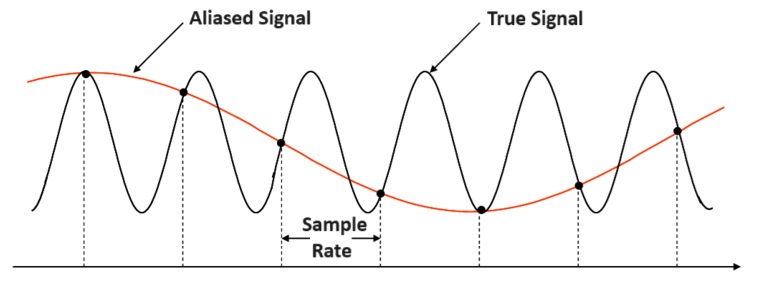
Making sense of the world can feel a bit like analyzing an aliased signal. All of us want to discover useful truths about life, armed only with our pitifully limited knowledge & exposure. So we make theories, and just when we think we’ve got the signal figured out… along comes an unexpected new insight (a higher frequency sample) and we discover that the rabbit hole is even deeper than we thought!
Why Greatness Cannot Be Planned
In the 2010’s a pair of computer scientists busy playing with a unique tool for generating random images accidentally made a profound discovery, widely applicable beyond their limited domain.
The tool, PicBreeder, allows users to interact with a pseudo-random image generator game. The user’s job is to simply pick the most interesting image over and over again. Every time you choose an image the system then generates 25 slight variations of it; The set of which you can from choose again…That’s it!
There’s no goal, & what constitutes ‘interestingness’ in an image is entirely at your discretion. Almost every image it generates is garbage, a cluster of random shapes. But over time as people played with the tool and evolved images over hundreds of sequential choices they would end up with images that look like recognizable objects. A skull, a car, and the image on the book cover. A butterfly.

The insight came when the scientists tried to recreate those images using PicBreeder starting from scratch. They couldn’t do it even though they knew the butterfly existed within the space of possibilities!
As it turns out, with respect to lofty ambitions, having a specific objective can be counter productive to achieving it. The objective becomes an unreliable compass used to guide your decisions.
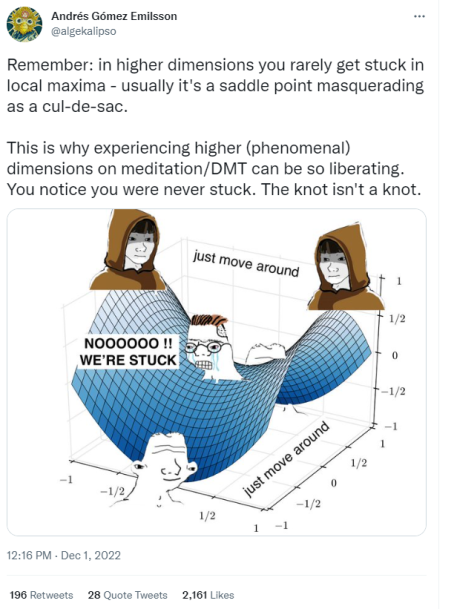
Imagine a robot using a literal compass pointing to the center of a labyrinth to navigate. If it’s search algorithm is simply ‘follow the compass’ then it ends up stuck on the nearest wall. A local optimum far from the desired result. You must deviate from the compass to make any further progress!
For every step of the labyrinth (except for the final straightaway) the compass ends up being a tool of deception; ultimately less useful for navigation than simply designing the search algorithm to ignore the compass & seek novelty instead.
Each of the turns within the labyrinth needs to be discovered and logged as an interesting thing. A possible stepping stone that may end up being part of the final path. This treasure hunting process can’t guarantee any particular result but it does reliably produce an array of options that can take you somewhere unexpected; To an interesting result that’s different but possibly even better than what you were looking for in the first place.
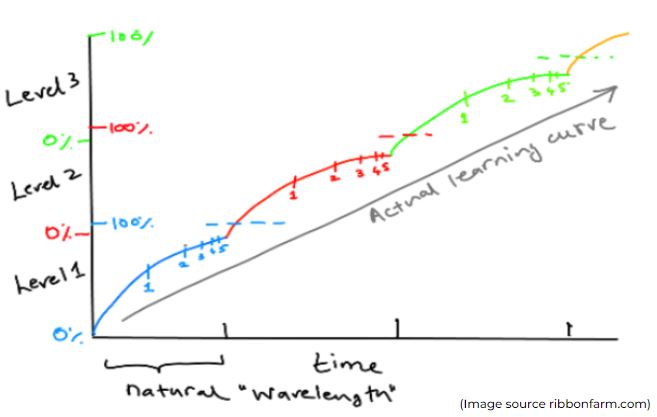
It’s a short book at 135 pages with basically 1 big idea that leaves me well convinced. As I read about the stepping stones I couldn’t help thinking of the chart I used in my slideshow intro: the ‘actual learning curve’. Which shows how a new strategy can fundamentally boost your skill to a new level, albeit with a diminishing return in a never ending process of seek, optimize, seek.
My one critique of the idea is that the authors did not address how easily a novelty search can morph into shiny object syndrome that distracts you from getting anything done. Sometimes a 1st order objective and settling at a local optimum is an acceptable place to end a search for the sake of getting things done. Progress > perfection.
So how might this idea be applied in the context of optimizing the explore vs exploit tradeoff?
Somehow I’ve written much about about serving the long tail of user demands, designing a product family, user-centered design, & modular design without ever realizing there was a name for an idea that can tie it all together.
Design For Emergence
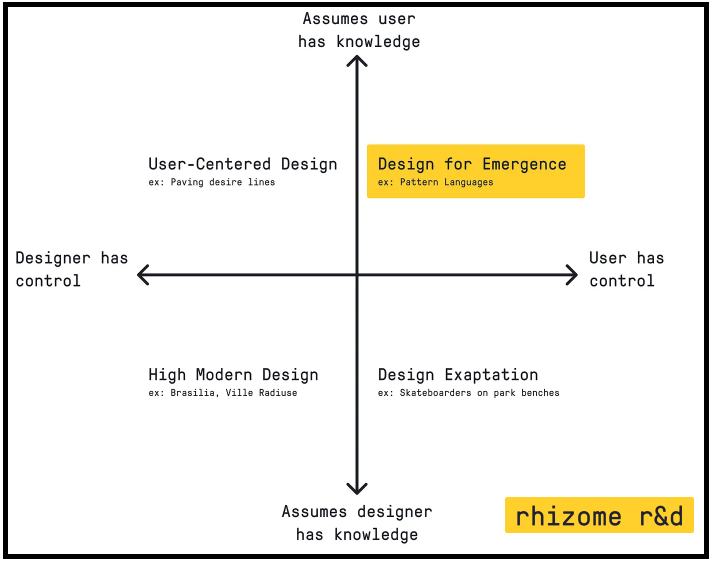
New design paradigm just dropped! (well, 1970-ish but new to me ) Kasey Klimes of rhizome R&D blog describes how design for emergence is a process where the designer assumes that the end-user’s knowledge is valuable enough to be worth granting them control over the design.
The idea is to empower end-users with the tools & environment to make it easy for them to solve their own problems. The resulting emergent solutions serve them better than the designer could ever do directly!
In other words, make tools of creativity & let your customers do your treasure hunting for you.

An excellent example immediately comes to mind & happens to be from a local company.
Electromage’s PixelBlaze wifi-enabled LED controller makes it easy to basically do anything you might want to do with addressable LEDs. I’ve never used it personally but I’ve seen some incredible work done with these that I have no idea how I would reproduce without that product.
The payoff to Electromage for offering the toolbox alongside this tool of creation is that they can (and do) profitably serve various customers at any point along the demand curve all at the same time. As a bonus, he can solicit feedback from customers through the app about how they are using this product, then use that information to hone future advertising.
- He can sell the devices in bulk wholesale (Mouser & Adafruit)
- He can sell the devices direct to customer retail to hobbyist makers to use as part of their products (Geek Mom Projects).
- He can use the devices himself and sell the service of customizing it to suit a customer-specific need. (Say, for a choreographed football halftime show.)
- As a result of the variety of creative end users he may unexpectedly discover that customers most commonly use this device to create choreographed exterior home Christmas lights; so he can start using those keywords on his landing page to drive more sales.

I’m not pursuing any projects of PixelBlaze caliber at the moment. (But I’d love to find one!) I think it’s helpful to at least have identified some habits that increase your likelihood of striking gold. (see, my scrolling habit isn’t entirely a waste of time!) along with a key characteristic that can make a good project great. Even if the whole vision isn’t clear, a silhouette can still be useful.

 EngineerDog.com